|
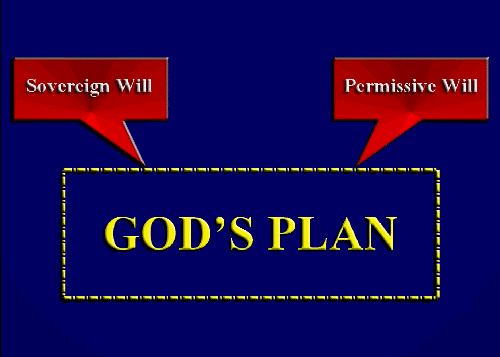
The continuous activity of God in His creation by which He preserves and governs. The doctrine of providence affirms God's absolute lordship over His creation and confirms the dependence of all creation on the Creator. It is the denial of the idea that the universe is governed by chance or fate.
Through His providence God controls the universe (Psalms 103:19); the physical world (Matthew 5:45); the affairs of nations (Psalms 66:7); man's birth and destiny (Galatians 1:15); man's successes and failures (Luke 1:52); and the protection of His people (Psalms 4:8).
Psalms 103:19
19 The Lord hath prepared his throne in the heavens; and his kingdom ruleth over all.
Matthew 5:45
45 That ye may be the children of your Father which is in heaven: for he maketh his sun to rise on the evil and on the good, and sendeth rain on the just and on the unjust.
Psalms 66:7
7 He ruleth by his power for ever; his eyes behold the nations: let not the rebellious exalt themselves. Selah.
Galatians 1:15
15 But when it pleased God, who separated me from my mother's womb, and called me by his grace,
Luke 1:52
52 He hath put down the mighty from their seats, and exalted them of low degree.
Psalms 4:8
8 I will both lay me down in peace, and sleep: for thou, Lord, only makest me dwell in safety.
God preserves all things through His providence (1 Samuel 2:9; Acts 17:28). Without His continual care and activity the world would not exist. God also preserves His people through His providence (Genesis 28:15; Luke 21:18; 1 Corinthians 10:13; 1 Peter 3:12).
1 Samuel 2:9
9 He will keep the feet of his saints, and the wicked shall be silent in darkness; for by strength shall no man prevail.
Acts 17:28
28 For in him we live, and move, and have our being; as certain also of your own poets have said, For we are also his offspring.
Genesis 28:15
15 And, behold, I am with thee, and will keep thee in all places whither thou goest, and will bring thee again into this land; for I will not leave thee, until I have done that which I have spoken to thee of.
Luke 21:18
18 But there shall not an hair of your head perish.
1 Corinthians 10:13
13 There hath no temptation taken you but such as is common to man: but God is faithful, who will not suffer you to be tempted above that ye are able; but will with the temptation also make a way to escape, that ye may be able to bear it.
1 Peter 3:12
12 For the eyes of the Lord are over the righteous, and his ears are open unto their prayers: but the face of the Lord is against them that do evil.
Divine government is the continued activity of God by which He directs all things to the ends He has chosen in His eternal plan. God is King of the universe who has given Christ all power and authority to reign (Matthew 28:18-20; Acts 2:36; Ephesians 1:20-23). He governs insignificant things (Matthew 10:29-31), apparent accidents (Proverbs 16:33), as well as man's good (Philippians 2:13) and evil deeds (Acts 14:16).
Matthew 28:18-20
18 And Jesus came and spake unto them, saying, All power is given unto me in heaven and in earth.
19 Go ye therefore, and teach all nations, baptizing them in the name of the Father, and of the Son, and of the Holy Ghost:
20 Teaching them to observe all things whatsoever I have commanded you: and, lo, I am with you always, even unto the end of the world.
Acts 2:36
36 Therefore let all the house of Israel know assuredly, that God hath made the same Jesus, whom ye have crucified, both Lord and Christ.
Ephesians 1:20-23
20 Which he wrought in Christ, when he raised him from the dead, and set him at his own right hand in the heavenly places,
21 Far above all principality, and power, and might, and dominion, and every name that is named, not only in this world, but also in that which is to come:
22 And hath put all things under his feet, and gave him to be the head over all things to the church,
23 Which is his body, the fulness of him that filleth all in all.
Matthew 10:29-31
29 Are not two sparrows sold for a farthing? and one of them shall not fall on the ground without your Father.
30 But the very hairs of your head are all numbered.
31 Fear ye not therefore, ye are of more value than many sparrows.
Proverbs 16:33
33 The lot is cast into the lap; but the whole disposing thereof is of the Lord.
Philippians 2:13
13 For it is God which worketh in you both to will and to do of his good pleasure.
Acts 14:16
16 Who in times past suffered all nations to walk in their own ways.
God acts in accordance with the laws and principles that He has established in the world. The laws of nature are nothing more than man's description of how we perceive God at work in the world. They neither have inherent power nor do they work by themselves.
Man is not free to choose and act independently from God's will and plan; he chooses and acts in accordance with them. In His sovereignty, God controls man's choices and actions (Genesis 45:5; Deuteronomy 8:18; Proverbs 21:1). God's actions, however, do not violate the reality of human choice or negate man's responsibility as a moral being.
(from Nelson's Illustrated Bible Dictionary, Copyright � 1986, Thomas Nelson Publishers)
Genesis 45:5
5 Now therefore be not grieved, nor angry with yourselves, that ye sold me hither: for God did send me before you to preserve life.
Deuteronomy 8:18
18 But thou shalt remember the Lord thy God: for it is he that giveth thee power to get wealth, that he may establish his covenant which he sware unto thy fathers, as it is this day.
Proverbs 21:1
21:1 The king's heart is in the hand of the Lord, as the rivers of water: he turneth it whithersoever he will.
God permits sinful acts to occur, but He does not cause man to sin (Genesis 45:5; Romans 9:22). He often overrules evil for good (Genesis 50:20; Acts 3:13).
Genesis 45:5
5 Now therefore be not grieved, nor angry with yourselves, that ye sold me hither: for God did send me before you to preserve life.
Romans 9:22
22 What if God, willing to shew his wrath, and to make his power known, endured with much longsuffering the vessels of wrath fitted to destruction:
Genesis 50:20
20 But as for you, ye thought evil against me; but God meant it unto good, to bring to pass, as it is this day, to save much people alive.
Acts 3:13
13 The God of Abraham, and of Isaac, and of Jacob, the God of our fathers, hath glorified his Son Jesus; whom ye delivered up, and denied him in the presence of Pilate, when he was determined to let him go.
|